PSPaudioware – PSP L’otary2 v2.2.0 VST, VST3, AAX for Windows


PSPaudioware – PSP L’otary2 v2.2.0 VST, VST3, AAX for Windows

Year/Date of Issue: 30/09/2026
Version: 2.2.0 (v2.2.0)
Developer: PSPaudioware
Developer's website: https://www.pspaudioware.com/products/psp-lotary2
Platform: Windows (x64)
Format: VST, VST3, AAX
Discharge: 64-bit
Tablet: Present (Cured / Pre-activated)
System requirements:
- Operating System: Microsoft Windows 7, Windows 8.1, Windows 10, Windows 11 (64-bit only)
- Processor (CPU): 64-bit Intel Core or AMD multi-core processor (SSE2 support required)
- RAM: 4 GB RAM minimum (8 GB recommended)
- Hard Drive: 150 MB available disk space
- Display Resolution: 1024 x 768 minimum
- Host Application: 64-bit VST2, VST3, or AAX compatible Digital Audio Workstation (Cubase, Pro Tools, Studio One, REAPER, Ableton Live, FL Studio)
An ultra-high-definition physical model of classic rotary speaker enclosures by PSPaudioware. Grounded in algorithmic analysis of the Leslie 122 and 147 hardware units, L’otary2 reproduces the complex acoustic reflections, inertia physics, Doppler pitch shifts, and tube preamp saturation of vintage mechanical cabinets.
- Dual Hardware Profiling: Authentic acoustic and electronic modeling of both the Leslie® 122 (warm, balanced organ tone) and Leslie® 147 (brighter, punchy front-end response).
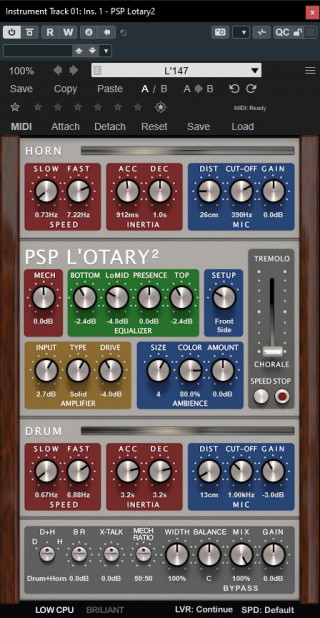
- Decoupled Rotor Mechanics: Independently configure the rotating high-frequency horn and low-frequency drum speeds, or isolate one while leaving the other static.
- Physical Inertia Engine: Authentic acceleration and deceleration ramp times simulate the physical weight and mechanical drag of rotating baffles and motors.
- Classic Speed Control: Traditional three-way lever switching between Chorale (Slow), Tremolo (Fast), and Brake/Stop modes, fully MIDI assignable.
- Integrated Tube Preamp: Onboard tube saturation engine with variable drive and input pad to push clean guitars, organs, and synths into warm harmonic breakup.
- Microphone Placement & Room Ambience: Adjustable mic distances, cut-off filtering, setup angles (Front/Rear), and an integrated room reflection section to place the cabinet into virtual physical spaces.
The Physics Behind L'otary2:
- Doppler & Amplitude Modulation: As the horn and wooden drum rotate, the acoustic wavefront undergoes cyclical frequency shifts (pitch vibrato) combined with directional amplitude drops (tremolo), producing the unmistakable shimmer of a physical Leslie.
- Internal Cabinet Cavity Reflections: Faithfully reproduces the resonances of the internal wooden louvers and baffle boards, preventing the flat or sterile response common to basic chorus plugins.
- Mechanical Noise & Crosstalk: Adjustable parameters for motor hum, mechanical bearing noise (Mech), and signal crosstalk between the high horn and low drum microphones.
-
Horn & Drum Sections:
- Independent Slow and Fast rotational frequencies (Hz).
- Adjustable Acceleration (Acc) and Deceleration (Dec) inertia timers.
- Dedicated microphone distance, high-pass/low-pass cut-offs, and gain controls for both high and low transducers.
-
Amplifier & Tone Shaper:
- Tube Amplifier: Input gain, amplifier type selector (122 vs. 147 circuits), and Drive control for authentic power-valve distortion.
- 4-Band Equalizer: Tailored Bottom, LoMid, Presence, and Top EQ bands for quick tonal matching in dense mixes.
-
Ambience & Spatial Controls:
- Room reflection engine with Size, Color, and Amount controls.
- Stereo Width, Balance, and Dry/Wet mix fader for parallel routing.
- D+H balance knob to blend the relative level between Drum and Horn.
- Binary Architecture: Native 64-bit Windows VST2, VST3, and AAX Native
- DSP Engine: 64-bit double-precision floating-point audio processing
- Sample Rate Support: 44.1 kHz, 48 kHz, 88.2 kHz, 96 kHz, 176.4 kHz, 192 kHz
- DAW Interoperability: Compatible with all major 64-bit Windows hosts:
- Avid Pro Tools (11+ / Ultimate)
- Steinberg Cubase / Nuendo
- Ableton Live
- PreSonus Studio One
- Cockos REAPER
- Image-Line FL Studio
- Bitwig Studio
Installation Steps:
-
Host Preparation:
- Close your DAW and host applications.
-
Run Installer:
- Launch the provided installer executable as Administrator (
Right-click -> Run as administrator). - Select your target plugin formats (
VST,VST3,AAX) and installation paths. - Complete the setup wizard.
- Launch the provided installer executable as Administrator (
-
Launch & Verify:
- The binaries are pre-cured and activated; no external license files or authorization tools are required.
- Open your DAW, initiate a plugin rescan, and load PSP L’otary2 onto an audio or instrument track.
Liens de téléchargement
| Inscrit: | 30, September, 2026 |
| Taille: | 61 MB |
| Pairs: | Sources: 1|Clients: 0 |
| Remercié: |
Galerie de captures
commentaires (0)
Connectez-vous pour commenter
Veuillez vous connecter à votre compte pour voir les commentaires de la communauté et partager votre avis.