ApulSoft - ApUnmask v1.0.8 VST, VST3, AAX for Windows


ApulSoft - ApUnmask v1.0.8 VST, VST3, AAX for Windows

Year/Date of Issue: 28/09/2026
Version: 1.0.8 (v1.0.8)
Developer: apulSoft
Developer's website: https://apulsoft.ch/apunmask/
Platform: Windows (x64)
Format: VST, VST3, AAX
Discharge: 64-bit
Tablet: present (Cured / Pre-activated)
System requirements:
- Operating System: Microsoft Windows 10 / Windows 11 (64-bit only)
- Processor (CPU): 64-bit Intel Core or AMD multi-core processor
- RAM: 4 GB RAM minimum (8 GB recommended)
- Hard Drive: 100 MB available storage space
- Display Resolution: 1280 x 800 minimum (Scalable vector GUI with Light, Dark, and Custom color themes)
- Host Application: 64-bit VST2, VST3, or AAX compatible Digital Audio Workstation
A psychoacoustic audio enhancer and spectral unmasking utility by apulSoft that reverses the principles of lossy perceptual coding. By utilizing the analysis stages of the Opus audio codec, apUnmask extracts time- and frequency-masked audio components that human ears normally overlook, allowing producers to sculpt and re-inject them for enhanced clarity, separation, and dimensional realism.
- Opus Codec Psychoacoustic Detection: Employs the psychoacoustic analysis algorithms from the Opus audio codec to identify and isolate components masked by louder transients and dominant spectral peaks.
- Reversed Lossy Compression Concept: Decades of lossy compression research focused on removing inaudible material to save bandwidth; apUnmask turns this on its head by isolating that hidden "ghost" material and restoring it to the mix.
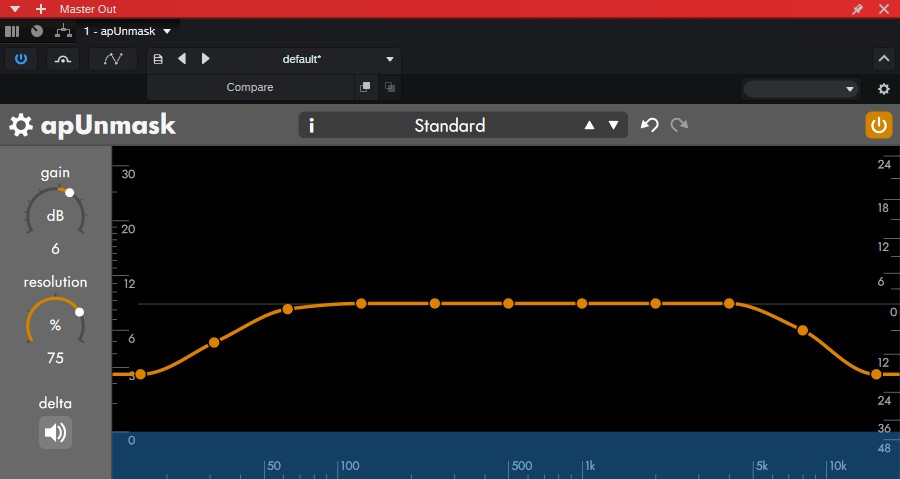
- Overshoot-Free Linear-Phase Bezier EQ: Shapes the extracted delta audio stream using high-precision linear-phase filtering with smooth Bezier curves that prevent phase smearing and pre-ringing artifacts.
- Dedicated Delta Audition Soloing: Instantly isolate and listen to the extracted masked content in real time to hear exactly what information is being retrieved.
- Mastering & Channel Utility: Functions as an invisible clarity enhancer on stereo master buses or as an intelligent dynamic exciter on drums, acoustic guitars, and vocals.
- Unlimited Undo / Redo & Human-Readable XML Presets: Full non-destructive parameter history alongside open, cross-platform XML preset files.
Understanding Audio Masking:
- Simultaneous (Frequency) Masking: Loud acoustic tones render softer neighboring frequencies inaudible to human perception within critical bands.
- Temporal Masking: Loud transient spikes temporarily desensitize human hearing immediately before (pre-masking) and after (post-masking) the transient event.
The apUnmask Mechanism:
- Rather than applying broad static harmonic distortion or standard dynamic high-shelf boosts, apUnmask analyzes the incoming audio using Opus perceptual models.
- It calculates the masking threshold across critical frequency bands and derives the exact delta signal that would otherwise be discarded.
- By providing dedicated Resolution, Gain, and Filter controls over this delta channel, users can selectively amplify sub-threshold musical nuance without increasing the overall peak volume of dominant instruments.
Step-by-Step Production Routine:
-
Insert & Calibration:
- Insert apUnmask onto your Master Bus, Drum Group, or Lead Vocal track.
- Adjust the input/master level until a steady, responsive delta signal is visible on the spectral display.
-
Isolate the Ghost Signal:
- Engage the Delta Audition button. You will hear only the faint, masked components that would typically be removed during perceptual coding.
-
Tune Resolution & Character:
- Sweep the Resolution control to calibrate the detector’s sensitivity to temporal vs. spectral masking boundaries.
-
Linear-Phase Frequency Sculpting:
- Use the graphic Bezier EQ curve to emphasize desirable frequencies in the delta channel (e.g., air above 10 kHz, snare ring in the upper-midrange, or subtle vocal breath) while rolling off unwanted low rumble.
-
Blend to Perfection:
- Disengage Delta Audition to return to the full mix.
- Blend the unmasked signal into the dry track to achieve three-dimensional presence and high-definition separation.
- Binary Architecture: Native 64-bit Windows VST, VST3, and AAX
- Processing Resolution: 64-bit internal floating-point DSP
- DSP Latency: 3128 samples at 44.1 kHz (reported directly to DAW delay compensation engine)
- Preset Format: Cross-platform, human-readable
.xmlformat (fully interchangeable across macOS, Windows, and Linux) - Visual Interface: Vector-rendered GUI with resizable scaling, contrast adjustments, and custom color scheme support
Compatible Digital Audio Workstations (DAWs):
- Image-Line FL Studio
- Ableton Live (All 64-bit versions)
- Steinberg Cubase / Nuendo
- Apple Logic Pro (via Windows host bridges)
- Cockos REAPER
- PreSonus Studio One
- Bitwig Studio
- Avid Pro Tools (AAX Native 64-bit)
Installation Steps:
-
Host Preparation:
- Close your DAW and any running audio host applications.
-
Execute Installer:
- Run the provided installer executable as Administrator (
Right-click -> Run as administrator). - Select your preferred plugin formats (
VST,VST3,AAX) and verify your target installation directories. - Complete the setup wizard.
- Run the provided installer executable as Administrator (
-
Launch & Verification:
- The binaries are pre-cured and activated; no external keygens, serial inputs, or online connections are required.
- Open your DAW, initiate a plugin rescan, and load apUnmask onto your master bus or track insert.
Download Links
| Registered: | 28, September, 2026 |
| Size: | 30 MB |
| Peers: | Seed: 2|Leech: 2 |
| Thanked: |
Screenshots Gallery
comments (0)
Sign in to leave a comment
Please sign in to your account to view community comments and share your thoughts.